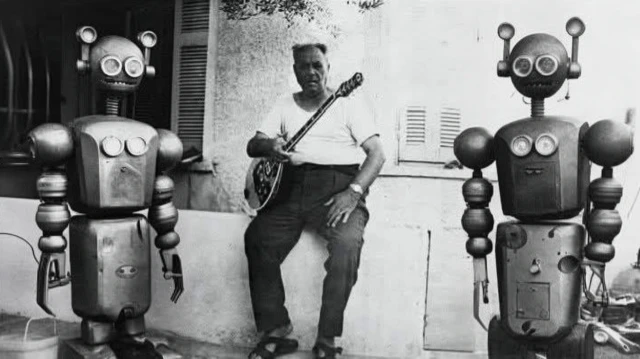
2,500 years ago, the people of Crete heard some weird news. The Athenians, it was said, had overthrown their rulers and started a peculiar experiment they named, "democracy".
Of course, no one could know whether this was true or simply rumors and fabrications. The only way to really know was to visit Athens yourself in the flesh.
That's how it always was with the news throughout the history of humankind. Everyone said whatever they pleased, and no one could know which of it held true and which didn't.
With one small parenthesis of roughly 204 years. From 1822, when the first photograph was taken, until 2026. Only during this period did technology temporarily give us the ability to be certain about whether an event had actually taken place.
And I say temporarily, because we now have the first organized disinformation campaign using AI photos and videos, concerning the developments in Venezuela in January, 2026.
Something similar had happened a few years ago with the simple use of Photoshop for propaganda purposes regarding the war in Ukraine.
This time last year, it was obvious to all of us whether a photo was AI-generated, given a slightly more careful look. Today, it is extremely difficult for the everyday person to determine that.
As of today, however, a professional can still detect whether a photograph is fabricated or not, whether AI has been used or simple digital editing.
But the capabilities that artificial intelligence offers act as an additional catalyst of progress, and so our capabilities are increasing exponentially.
Most likely, though, one year from now, not even professionals will be able to verify the authenticity of any digital material. And, no. Watermarking is not the answer.
With international geopolitical tensions constantly rising, there are many who will have an enormous incentive, in the very near future, to try to manipulate public opinion with fabricated AI material.
This will continue for some time, until it becomes clear in our collective consciousness that we are returning to the era before the invention of photography.
So it is a good idea for us to gradually adopt a new rule in our lives, until some technology for detecting the authenticity of digital material is created (IF it is ever created):
Whatever we see on a screen is now most likely fake. We are heading back, full steam ahead, to the era when truth is only what you see with your own eyes.
It is the best way to help an independent voice in an age where the algorithms of "social" media only promote low quality content for the clicks.


