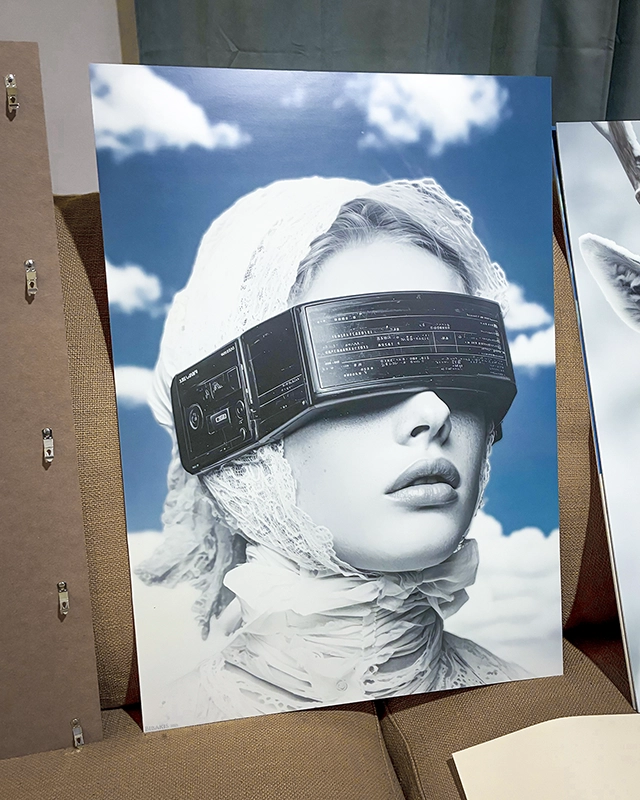
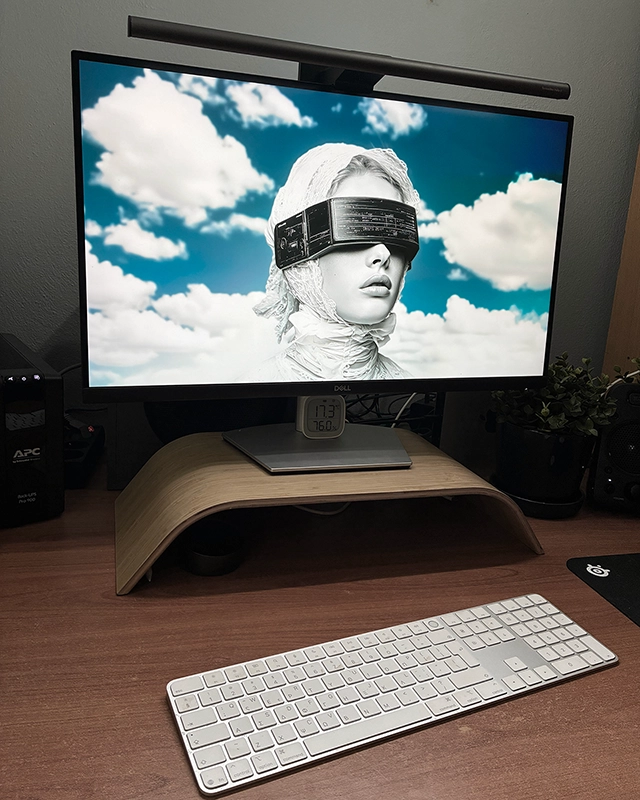
One of those boring winter nights, I traveled with my time machine to London in the year 2222. I found this device that everyone wears there, then went back to 1722 to a little village called Williamsburg in Virginia, USA, to show it to them.
I photographed Elizabeth Miller, the farrier’s daughter, looking at images from the future, 500 years ahead of her time. I titled this photograph, “Peasant Girl.”
In this way, I wanted to capture the shock humanity experienced in the period 2024–2025, when artificial intelligence spread into our daily lives. We too suddenly saw images from a future that, even today, still struggle to fully comprehend.
There has not been a more world-shaking change on our planet since we climbed down from the trees. Think carefully for a moment about the following sequence: plants > animals > humans > machines. It is the first time that an intelligent organism does not exist within a biological body.
I distinctly remember telling my mother at the beginning of 2024, that in the next five years of her life, she would experience more changes around her than she had in the previous 65 years.
And indeed during 2025, one of the most difficult professions, the programmer, my own profession, passed entirely into the hands of machines.
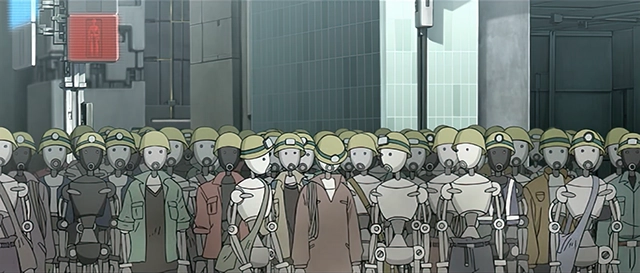
You would have to be crazy to write code for 8 hours when Claude Code can now produce the same, or better result in half an hour. It is an astonishing programmer that you can use 24/7 at a cost of less than 20€ a month.
You would have to be crazy to visit "websites" to do any kind of research and get tangled up in the circus that the internet has become in 2026. Every website has different colors, different fonts, a different layout. Not to mention the dozens of cookie notifications, newsletter pop-ups, and all the rest. Chatbots offer the same information in a user interface you can actually use without getting a headache.
And what comes immediately after all this? Obviously, the next target is the rest of the "office" professions, where 95% of the work is simply information management.
Why should a lawyer spend a week reading and analyzing legislation when a specialized AI system will soon produce the same result in half an hour? Exactly the same applies to every profession in the financial sector, from ordinary accountants to stockbrokers and economists.
There will always need to be an experienced human at the wheel of these AI systems to supervise, correct, and direct them. But that does not change the fact that 95% of the volume of modern work will simply have disappeared much sooner than you think.
How will humanity handle a 2029 (or even a 2039) in which 50% or more of the population will be unemployed? Who will legislate so that our societies can confront these world-shaking challenges? Half our politicians right now probably could not even tell the difference between email and Facebook. And that is perfectly logical, as the same is true of the people who vote for them.
But what is truly terrifying is what will come a little later, when the replacement of manual labor becomes inevitable as well. Anyone who has seen Boston Dynamics’ terrifying videos understands exactly what I mean.
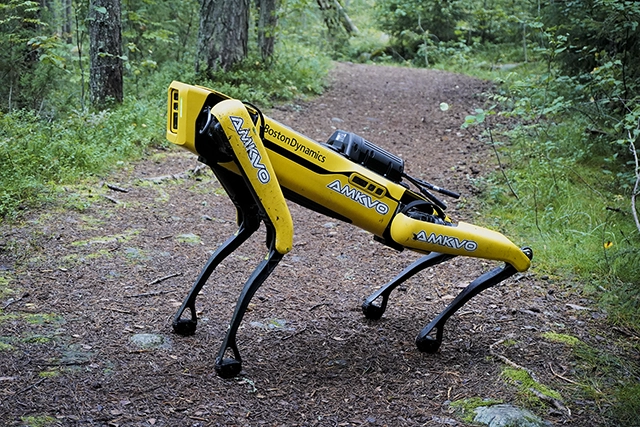
What company will be able to keep paying a human being 2.000€ a month for something a machine will be able to do in 4 hours for less than 1% of the cost? And even if it does for humanitarian reasons (or even forced to do so), how will it manage to compete with the companies that will move rapidly to 100% mechanized labor?
All our political systems, our ideologies, our entire human way of thinking, deal at their core with the management and distribution of resources and labor. What will we do when no one pays human beings to work anymore? What will we do when the value of our labor, and consequently the value of our very existence, is completely reduced to zero?
Which state will provide even that so-called “minimum guaranteed income” that is so widely discussed? Where will governments find the economic strength to do so? With what power will we the weak ones, aka the nations of human beings, force fully mechanized, all-powerful multinationals to share their wealth with us? And what reason will they have to do that? Obviously none.
As human history teaches us in cases such as the discovery of America by the Europeans, the weak always step aside and surrender their entire world to the stronger conqueror. And if they resist, they are simply erased.
Good luck to all of us.
Αυτό το άρθρο είναι διαθέσιμο επίσης στα ελληνικά: Το τέλος της εργασίας.
It is the best way to help an independent voice in an age where the algorithms of "social" media only promote low quality content for the clicks.